
A Florida owner may submit an exemption application and still be unable to find a certificate in a public search. That does not necessarily mean the application was denied. The Florida Division of Workers’ Compensation (DWC) uses separate tools for an applicant’s case status and for the public exemption search. Knowing which system answers which question prevents a pending application, an issued certificate, and an employer’s coverage record from being treated as the same thing.
Use the applicant portal to check a pending application
The official Notice of Election to Be Exempt portal lets an applicant apply, renew, check application status, and print a certificate. Sign in using the account and business information used in the filing. Locate the exact application, save a dated status record, and note any request for correction, payment issue, or eligibility question. The DWC says it has 30 days from receipt of the notice to review and determine eligibility. That is the agency’s review period, not a promise that every application will be approved on day 30. If the application is pending, compare the submission receipt with the portal entry: applicant name, business legal name, construction or nonconstruction classification, ownership role, and application date. Confirm whether the portal shows the required tutorial, attestation, fee, or supporting information as complete. The state’s published rules and portal prompts control; do not start a second application just because the first status is not immediately visible.

Use the public Exemption Search after issuance
The public Exemption Search is a verification tool for an issued exemption. Florida states that exemption information appears in the search database on the day following issuance. A newly approved certificate may therefore be printable in the applicant portal before it appears in the public search. When the search returns no result, check the issue date first, then try the exact owner name, employer name, and business classification shown on the certificate. Search variations are troubleshooting steps, not proof of eligibility. The applicant portal’s certificate is the best record for the owner’s issued election; the public search is useful for third parties checking whether that record is visible. Neither should be confused with the employer’s workers’ compensation policy. Use the state’s Proof of Coverage tools for policy questions. A valid owner exemption does not remove a company’s obligation to cover employees when Florida law requires coverage.
If the record is still missing
Confirm that the application is approved rather than submitted or pending. Check spelling, punctuation, former names, legal entity, and the correct construction/nonconstruction selection. If more than a day has passed since issuance and the public search still does not show it, preserve a screenshot of the certificate and search, then contact the DWC exemption office using the official contact information on its page. Ask whether the certificate is active and whether the public search record needs correction. Do not email unnecessary personal or financial data. If the portal shows a returned payment or an eligibility issue, follow the agency notice. The official portal says the Division is the authority that processes and approves exemptions; a payment receipt alone is not an approval. For construction exemptions, check the current fee, ownership qualification, maximum number of exempt officers or members, and other eligibility rules in the live portal and statute before representing the exemption to a contractor.

Track certificate validity and renewal
Florida says exemptions are valid for two years after the effective date. The portal also cautions that the renewal button is for an existing holder seeking renewal and that an application received more than 90 days before expiration can make the prior exemption for the same business null and void. Read the current portal instructions and certificate date before filing early. Put the effective date, expiration date, and an internal reminder on the calendar, then verify the renewed certificate rather than relying on the submission receipt.
Build a verification packet
Keep the submitted application, payment receipt if applicable, status screenshot, issued certificate, public search result, ownership record, and agency correspondence together. For a contractor or project owner, provide the certificate only for the owner and entity it names; separately provide the company’s employee coverage evidence. Recheck the state record when work begins and when the certificate renews. This guide describes the Florida process generally; the live DWC portal and facts of the business control the individual result.## A status-reconciliation checklist for Florida owners Use a small evidence table with one row for the applicant and each material portal field: exact legal name, entity type, qualifying role, state business record, qualifying construction or non-construction classification, license number if applicable, application or certificate number, effective date, expiration date. Mark each item confirmed, inconsistent, or not applicable. This is especially helpful when a company has changed its name, added a member, converted from a sole proprietorship, or used a trade name on a project contract. The name on the exemption record should be reconciled to the entity that actually performs the work.
Save the initial submission receipt and check the portal status periodically while it is pending. If DWC asks for more information, preserve the request and respond through the stated channel. Avoid filing a second application just because the first is not immediately visible; first determine whether it is pending, issued, returned for correction, or associated with a different legal name. When a certificate is issued, download it and verify its holder, category, effective date, expiration date, and any conditions. Florida’s portal describes the exemption as valid for two years and says newly issued information appears in the public search on the following day. If the public listing still does not match after that period, contact the Division with the certificate number rather than treating a search typo as proof that the certificate is invalid.

Renewal timing and changes during the term
Put the expiration date on a calendar with reminders well before the renewal window. The Florida portal warns against renewing more than 90 days before expiration because doing so can nullify the prior certificate. Recheck that instruction on the live portal before acting, since portal instructions and forms can change. A change in ownership, officer or member status, entity form, business activity, or qualifying work can affect whether the person still meets the exemption conditions. Do not wait until the next renewal to investigate a material change: compare the change with the current statute and DWC guidance, and ask the agency or qualified counsel when the portal does not address the facts.
Keep the exemption separate from the employer policy
The certificate is evidence about the named owner’s election. It does not insure employees, subcontractors, or another entity and does not establish that a general contractor has satisfied every project-specific verification duty. Maintain the employer’s workers’ compensation policy or other applicable proof in a separate file. Before allowing an owner to begin work under a certificate, confirm the public record, certificate dates, exact business identity, and the contract’s own insurance requirements.
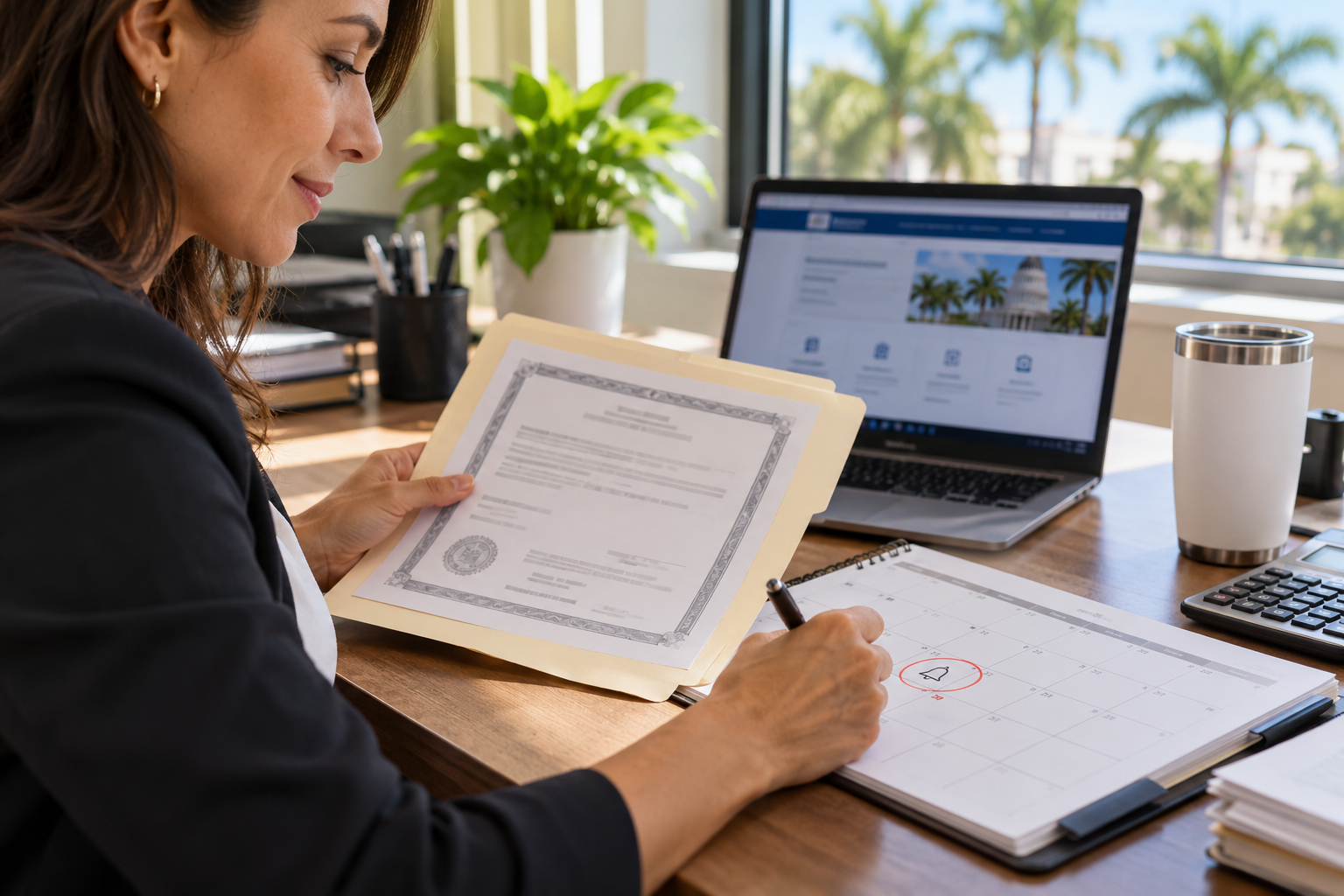
Keep a dated evidence trail
A useful file contains the original application snapshot, the issued certificate, the public-search result, and any follow-up with DWC, each labeled with the date it was retrieved. That lets a project administrator explain whether a discrepancy reflects a delayed listing, an outdated printout, or a change in the applicant’s status. Limit access to personal identifiers and store them with the company’s other compliance records. Recheck the official portal immediately before a new contract or permit submission; a certificate that was valid last season should not be treated as current without checking its expiration and matching identity.